
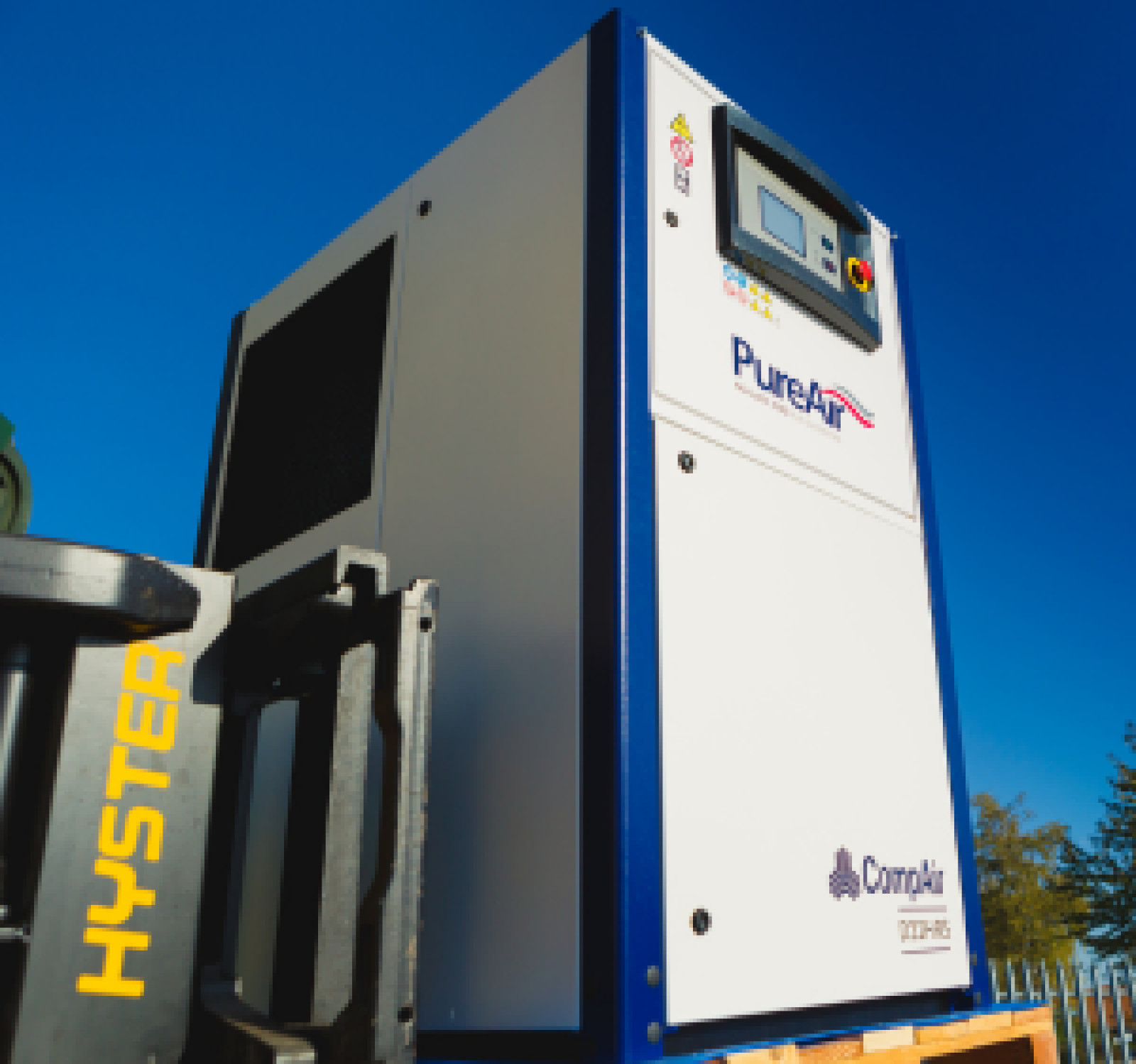
Discover how oil-free compressors deliver clean, reliable air for critical applications.
When you’re deciding on a compressed air system, one of the first questions is whether to choose an oil-lubricated or an oil-free compressor. At first glance the difference seems simple, but the way the two systems are built – and the results they deliver – are very different.
In this blog, we explain how oil-free compressors work, how they compare to oil lubricated compressors, and which one is right for your business.
How do oil-free air compressors work?
Oil-free technology is about redesigning the way compression happens to protect air quality from the start. In simple terms, these systems take in ambient air, compress it, and deliver pure air without the risk of contamination.
Unlike oil lubricated versions, where oil is injected directly into the compression chamber, oil-less air compressors rely on specialist coatings, advanced engineering, or water injection to reduce friction and heat. For example, some rotary screw designs use counter rotating screw elements that never touch, which allows compression to happen without lubrication.
The benefit is that there are no oil particles in the air stream, which means you achieve guaranteed air purity. That level of contaminant free air is especially important in industries that need class zero air certification, such as food packaging or pharmaceuticals, where even the smallest trace of oil could cause air contamination and product loss.
Of course, there are trade-offs. Oil-free machines often produce slightly less compressed air under the same load, and they can run hotter than their oil free counterparts that rely on lubrication. But the savings on maintenance costs can offset this, since there are no oil changes and fewer consumables. Businesses may still need air filters or other air treatment solutions to meet the very highest standards, but those filters don’t have to work nearly as hard when oil is removed from the process.
What an oil-free compressor really is
The term “oil-free” can be a little misleading. These machines still use oil in some areas, such as the gearbox, but the compression chamber itself is kept clear. That’s the part that matters, because it’s where the air is compressed before leaving the system.
Instead of relying on oil for lubrication and cooling, oil-free compressors use other methods. The moving parts might be coated in friction-reducing materials, or designed so that they don’t actually touch. In some models, water replaces oil to cool and seal the process. However it’s achieved, the purpose is the same – keeping the air stream completely clean.
For industries where even a trace of contamination can cause problems, clean air is the main reason oil-free technology exists.
How this differs from an oil-lubricated system
In an oil-lubricated compressor, oil is introduced directly into the compression chamber. It forms a seal, cuts down friction, and carries away heat. That design makes the machine durable and efficient, which is why oil-lubricated compressors are common in heavy-duty industrial environments.
The downside is that oil and air mix in the chamber, so filters are needed to prevent contamination. Even with careful filtration, there’s always the possibility of oil making its way into the final air supply.
Oil-free compressors avoid that risk altogether. But because they don’t have oil to absorb heat or cushion wear, they usually run hotter, can be noisier, and in some cases may not last as long when used continuously.
The different types of air compressors
Air compressors don’t all work in the same way. The design of the machine affects how air is delivered, how much pressure it can generate, and how suitable it is for different applications.
The most common types include:
- Rotary screw compressors – A popular choice in industry, these use two interlocking rotors to compress air in a continuous, steady flow. They’re reliable for larger-scale operations and can be built as either oil-injected or oil-free screw compressors.
- Reciprocating (piston) compressors – These use a piston driven by a crankshaft to compress air into a storage tank. They’re often used for smaller jobs or in workshops where demand is intermittent.
- Centrifugal compressors – These are larger machines that use high-speed rotating impellers to generate compressed air. They’re suited to facilities with very high and constant demand.
Each type has its own advantages, but they all come back to the same principle: taking in atmospheric air and compressing it to the level required for the job. Understanding which design works best depends on factors like air demand, purity requirements, and the total cost of ownership.
Why businesses choose oil-free
The clearest reason is air quality. If contamination simply isn’t acceptable, an oil-free system removes the risk. There are practical benefits too. With no oil changes and fewer filters to replace, maintenance can be lighter. Some units are also more compact, which makes installation and movement easier. And with water-injected models in particular, environmental performance is improving as well.
It’s worth remembering, though, that oil-free isn’t always the best fit. In plants where compressors run all day, every day, an oil-lubricated system may prove more robust. They’re generally quieter and cooler in operation, and in some cases more efficient.
Understanding the wider picture
When people talk about air compressors, the conversation often comes down to choosing between oil lubricated air compressors and oil-free designs. In practice there are more shades of grey. For example, some machines are described as technically oil free. These systems still have oil in parts of the mechanism but use a separation process and filtration so that the air itself is classed as oil-free.
There are also different terms used across the industry. An oil injected compressor is another way of describing an oil lubricated model, because the oil is actively introduced into the compression chamber. An oil injected air compressor delivers the durability benefits of that design, but it comes with the same consideration around air quality. On the other side, businesses that need guaranteed purity often invest in oil free compressed air equipment, where the technology removes the risk of contamination altogether.
Whatever route is chosen, the important point is understanding how the design affects the quality of the compressed air itself. That way, you can balance durability, efficiency and purity, and make a choice that suits your application.
Choosing between oil-free and oiled
The choice really depends on your priorities. If you need guaranteed purity, oil-free is the safe option, supported by advanced filtration systems that remove even the smallest contaminants to maintain clean, high-quality air.. If your focus is on long-term durability under demanding conditions, oil-lubricated compressors are often the stronger choice.
At Direct Air, we work with both types across a wide range of industries. That means we can look at your requirements and recommend the right solution – whether that’s protecting product quality with oil-free air, or relying on the strength and longevity of an oil-lubricated system.
Final thoughts
Oil-free compressors are designed with one goal: to keep the compression chamber clear of oil so the air supply is guaranteed clean. Oiled compressors, by contrast, use oil to improve performance and lifespan, but with the trade-off of possible contamination.
There isn’t a universal answer to which is “better.” It comes down to the application. If you’d like to talk through the options and find the right fit for your business, get in touch with Direct Air.