
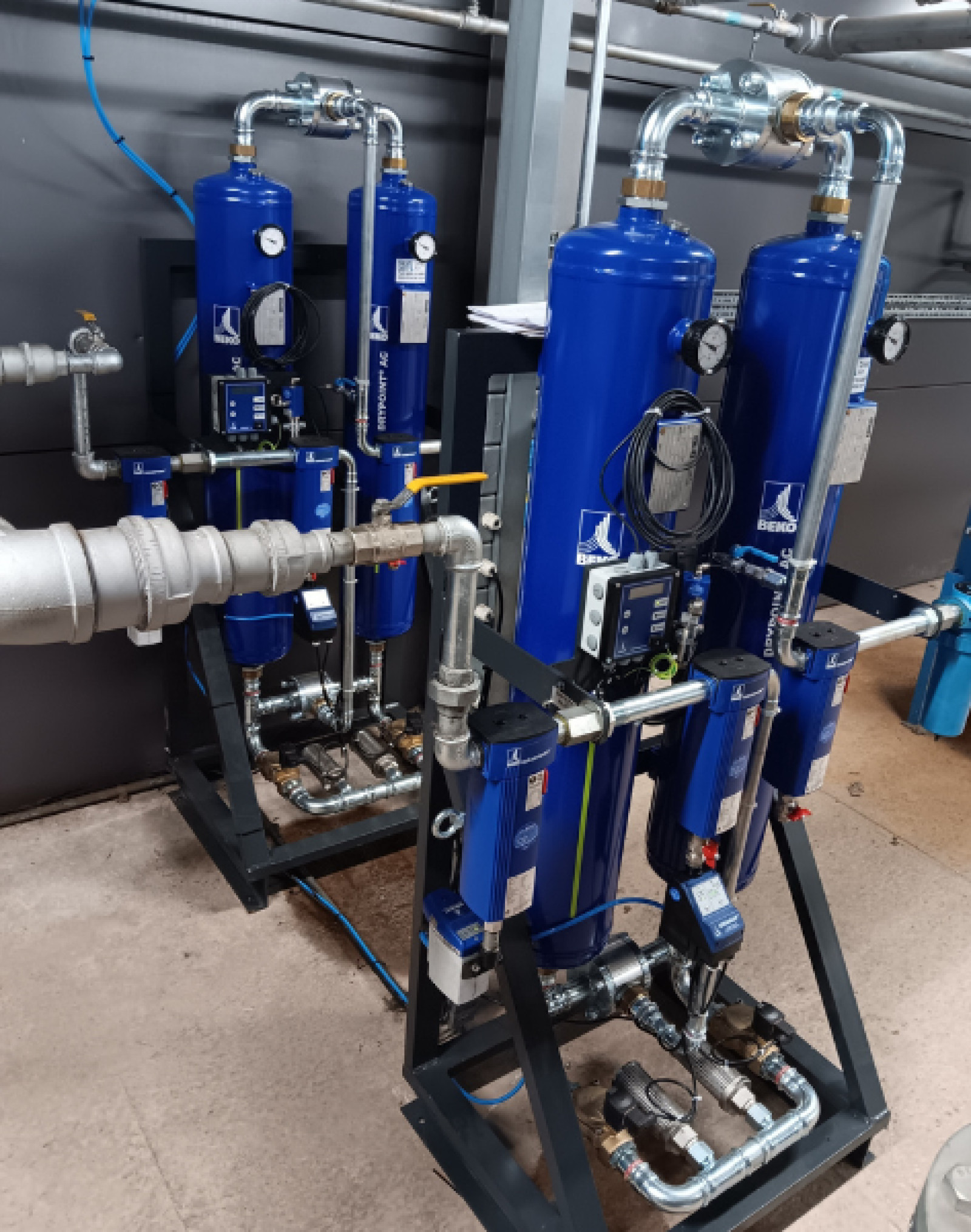
Compressed air dryers protect systems from moisture, corrosion and costly downtime. Learn why they are essential for reliable compressed air performance.
When businesses invest in a compressed air system, the focus is usually on the compressor. Capacity, pressure, energy use. All important.
But the part that often gets overlooked is the dryer.
That’s where problems start.
Because every compressed air system produces moisture. And if that moisture is not removed properly, it will cause damage somewhere down the line.
This isn’t a theory. It’s physics.
Compressed Air Always Contains Water
The air we breathe contains moisture. When you compress it, you increase the concentration of that moisture.
Hot compressed air leaves the compressor carrying water vapour. As that air cools in the system, the vapour condenses into liquid water.
Without a properly specified compressed air dryer, that water ends up in pipework, valves, cylinders, air tools, production equipment, and sometimes even the finished product.
The result is corrosion, contamination, and premature failure.
Moisture is not a minor issue. It is one of the biggest causes of compressed air system problems.
What Happens When Drying Is Ignored
We regularly see systems where the compressor is well maintained, but the air treatment side has been neglected.
The impact shows up as rusted pipework, sticking pneumatic actuators, failed solenoid valves, increased filter element changes, water pooling at low points, product quality issues, and frozen lines during winter.
In food, pharmaceutical or electronics environments, poor air quality can even lead to product rejection or audit failures.
The cost of a properly specified dryer is small compared to the cost of downtime or damaged equipment.
What Is Dew Point and Why It Matters
Pressure dew point is one of the most important concepts in compressed air drying, yet it is often misunderstood.
In simple terms, dew point is the temperature at which moisture in compressed air turns into liquid water.
The lower the dew point, the drier the air.
For most general industrial applications, a refrigeration dryer delivering a +3°C pressure dew point is sufficient.
For more demanding environments such as outdoor pipework, cold production areas, instrument air, paint spraying, or pharmaceutical production, a desiccant dryer delivering -40°C or lower may be required.
The right dew point depends on the application. Over-specifying increases energy costs. Under-specifying creates risk.
Refrigeration vs Desiccant Dryers
Refrigeration dryers are best suited for general industrial use. They typically deliver a +3°C pressure dew point, have lower capital cost, lower energy consumption, and are reliable and simple to maintain.
For most factories, workshops and manufacturing plants, this is the correct choice.
Desiccant dryers are designed for critical or low-temperature applications. They deliver a pressure dew point of -40°C or lower, prevent freezing in pipework, and are required for high-spec air quality.
They cost more to run due to purge air or blower operation, but in the right environment they are essential.
The key is specification based on real operating conditions, not assumptions.
Signs Your Compressed Air Dryer Is Not Performing
Even if a dryer is installed, that doesn’t mean it’s doing its job properly.
Common warning signs include visible water in air lines, corrosion in downstream filters, frequent filter replacements, dew point alarms or unstable readings, automatic drains constantly discharging, and production issues that seem unrelated to air.
Many dryers continue running even when performance has dropped. Without monitoring dew point and carrying out routine maintenance, issues go unnoticed.
By the time the problem is visible, damage has often already occurred.
The Energy Efficiency Factor
Dryers also impact energy performance.
An oversized dryer wastes capital and power. An undersized dryer struggles during peak demand, allowing moisture carryover.
Poor maintenance creates further inefficiencies such as blocked condenser coils increasing power draw, faulty drains wasting compressed air, and desiccant that has reached the end of its life reducing drying performance.
A well-maintained dryer protects both your equipment and your energy costs.
Compressed air is already one of the most expensive utilities in a factory. Air treatment should not be an afterthought.
Maintenance Is Not Optional
Dryers require regular inspection and servicing.
For refrigeration dryers, clean condenser coils, check refrigerant performance, and test and service automatic drains.
For desiccant dryers, monitor dew point, inspect switching valves, and replace desiccant when required.
Ignoring maintenance doesn’t save money. It shifts cost into breakdowns and production disruption.
Air Quality Is System Protection
Compressed air dryers are not optional extras. They are protection devices.
They protect your pipework, your equipment, your product, your compliance, and your operating budget.
When specifying or reviewing a compressed air system, the question should not be “Do we need a dryer?”
The question should be:
Is our dryer correctly sized, correctly maintained, and delivering the right dew point for our application?
Moisture problems rarely appear overnight. They build slowly, then fail suddenly.
Getting the drying right from the start prevents the issues most businesses only notice when it’s too late.